
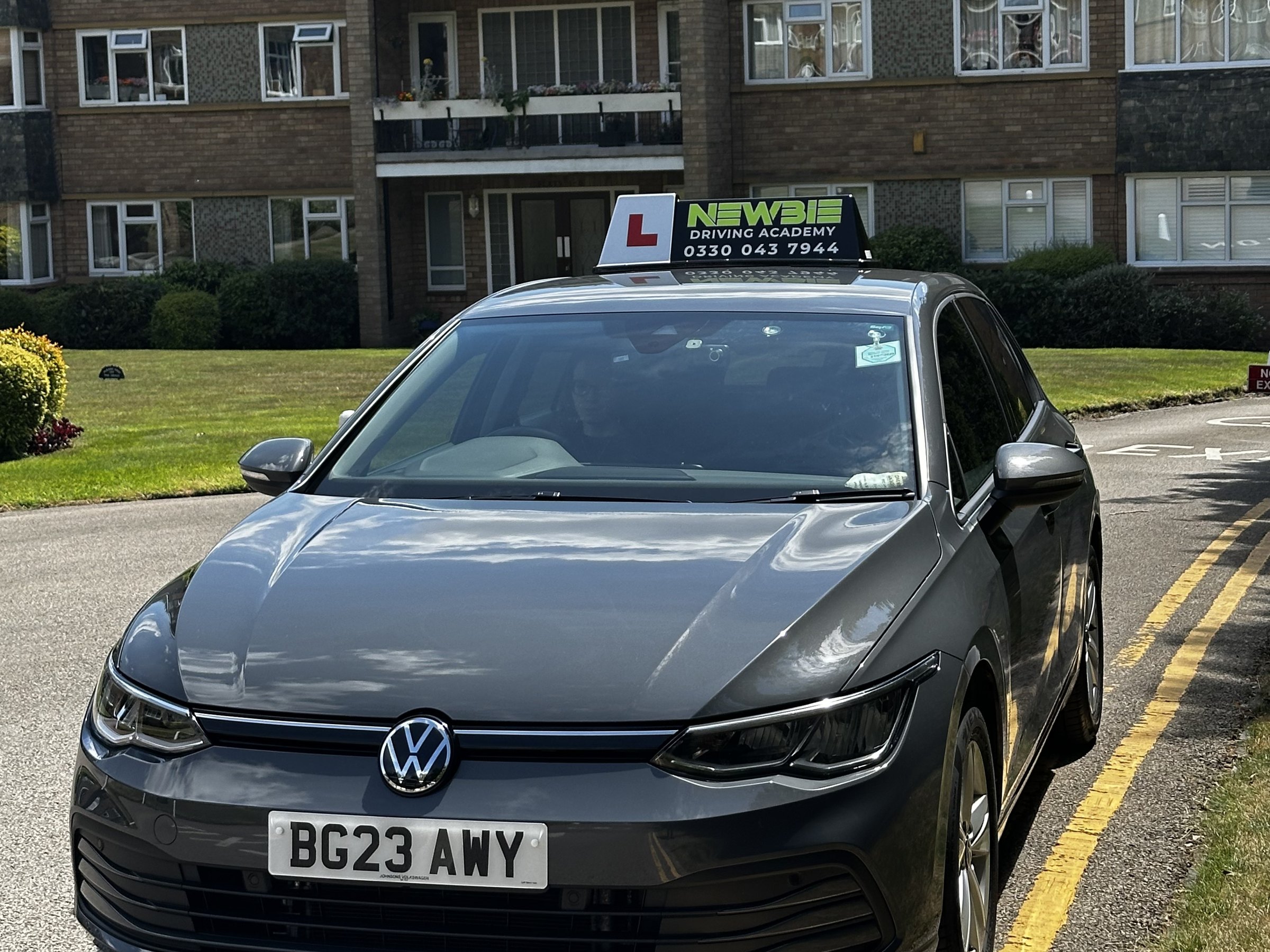
Before you've even pulled away on your driving test, the examiner wants to know one thing: do you understand the car you're about to drive? That's what the Show Me, Tell Me questions are for.
They're short, practical checks taken from the official DVSA list. One asks you to explain a safety check. The other asks you to use a control while you're driving. Neither is designed to trip you up, and once you've practised them a few times, they become some of the easiest marks on the test.
Below you'll find all 21 questions with simple answers written by our instructors in Birmingham. You don't need to learn them word for word. You just need to understand what each check is for.
How it works on the day
While you're parked, the examiner asks one Tell Me question. You explain how you'd do the check. No need to get out of the car.
Somewhere on the drive you'll get one Show Me question. You operate the control when it's safe, while staying in full control of the car.
Get one wrong and it's usually a single driving fault. It only becomes serious if using a control makes you lose control or puts anyone at risk.
The 7 Show Me questions
Each one starts with "When it's safe to do so, can you show me how you'd…". You don't need to say anything. Just do it calmly, keep your eyes up, and switch it off again afterwards.
…wash and clean the rear windscreen?
Use the rear washer control on the wiper stalk (often a push or a twist of the end). One short spray and a wipe is enough, then turn it off.
…wash and clean the front windscreen?
Pull the wiper stalk towards you to spray the washer fluid. The wipers will sweep a few times on their own. Let go and carry on driving.
…switch on your dipped headlights?
Turn the light switch to the dipped beam symbol. A green light on the dashboard tells you it's on. Make sure you haven't gone one click too far into fog lights.
…set the rear demister?
Press the button showing a rectangle with wavy arrows. A small light on the button confirms it's working. It's the rectangle, not the curved windscreen shape.
…operate the horn?
A quick, firm press on the centre of the steering wheel. Keep both eyes on the road and your other hand steady on the wheel.
…demist the front windscreen?
Point the airflow at the windscreen, turn the fan up and the heat on. Air conditioning clears mist faster, and many cars have a one-touch front demist button.
…open and close the side window?
Tap the driver's window switch to lower it a few centimetres, then raise it again. There's no need to open it all the way.
Road first, question second
If a car pulls out or you're mid-roundabout, deal with that first. The examiner is happy to wait until it's safe.
The 14 Tell Me questions
You'll be asked one of these before you drive off. Talk the examiner through the check in your own words. Tap a question to see the answer.
Brakes & safety systems
Press the pedal. It should feel firm, not soft or sinking to the floor. As you move off, test them gently. The car should slow evenly without pulling left or right.
The ABS warning light on the dashboard. If it stays on after starting the engine, or comes on while you're driving, there's a fault with the system.
Hold light pressure on the wheel as you start the engine. You'll feel it move slightly as the system kicks in. Or, once you're moving, the steering should feel light. If it feels heavy, something's wrong.
The firm part should sit level with your eyes or the top of your ears, and as close to the back of your head as is comfortable. Some head restraints are fixed and can't be moved.
Tyres
In the car's handbook, and often on a sticker inside the driver's door or fuel flap. Check them when the tyres are cold using a reliable gauge, include the spare if there is one, and put the valve caps back on.
Look for cuts, bulges or anything stuck in the rubber. The tread must be at least 1.6mm deep across the middle three-quarters of the tyre, all the way around.
Lights & indicators
Turn the ignition on if needed, switch the lights on, then walk around the car to see that each one is lit.
Switch on the hazard warning lights (ignition on if needed) so every indicator flashes, then walk around the car to check them all.
Press the brake pedal and watch for the red glow in a reflection, like a garage door or shop window. Or ask someone to stand behind the car and tell you.
With the dipped headlights on, push the light stalk away from you. A blue headlight symbol on the dashboard shows main beam is on.
Switch on dipped headlights first, then press the rear fog light switch. An amber warning light confirms it's on. Only use them when you can't see further than about 100 metres.
Under the bonnet
Point to the dipstick (usually a bright yellow or orange handle). Pull it out, wipe it, push it back in, then pull it out again. The oil should sit between the min and max marks. Some cars show this on the dashboard instead.
Point to the see-through coolant tank. The level should be between the min and max lines. Top it up with the right coolant if it's low, and never open the cap when the engine is hot.
Point to the brake fluid reservoir, usually near the back of the engine bay on the driver's side. Check the fluid is between the min and max marks.
Don't learn 21 answers. Learn 4 groups.
Our instructors teach the Tell Me checks as a walk-around of the car. Once you can picture where each check happens, the answers follow naturally.
Under the bonnet
Oil, coolant, brake fluid. All "between min and max".
Tyres
Pressure from the handbook, tread at 1.6mm minimum.
Lights
Switch on, then walk round or use a reflection.
From the seat
Brakes, ABS, steering, head restraint.
Where learners slip up
These are the mistakes our instructors see most often on mock tests, and how to avoid each one.
Looking down for too long
Find the controls by feel during lessons so on the day it's a glance, not a stare.
Drifting while using a control
Steering wobbles are the real risk. Keep one hand firm on the wheel and your speed steady.
Front and rear mix-ups
Wipers and demisters each have a front and rear version. Learn which symbol is which.
Forgetting to switch off
Wipers left on or a window left open looks careless. Finish the job, then carry on.
Answers that are too vague
"I'd check the tyres" isn't enough. Say what you're looking for, like 1.6mm of tread.
Answering the wrong question
Nerves blur brake lights into headlights. Let the examiner finish, pause, then answer.
How our instructors get you ready
Two questions, every lesson
We drop one Show Me and one Tell Me into each lesson at random, so you're never cramming the night before.
Learn the car you'll test in
Controls move between makes. Sit your test in your Newbie lesson car and you'll already know where everything is.
Understand the why
Know why a check matters and the answer sticks, even if your mind goes blank.
Practise on a mock test
Our mock tests include both questions in test conditions, so the real thing feels familiar.
Frequently Asked Questions
Two in total: one Tell Me before you set off and one Show Me while you're driving.
Not usually. A wrong answer, or getting both wrong, normally counts as one driving fault. You'd only fail if using a control on the move caused you to lose control or put someone in danger.
No. The examiner just needs to hear that you understand the check. Your own words are absolutely fine.
There's no published list of favourites. Examiners can pick any of the 21, so it's worth knowing them all.
Yes. If you didn't catch it or you're unsure what's being asked, just ask. It's much better than answering the wrong question.


